


Exodus Week 3: Small Group Guide
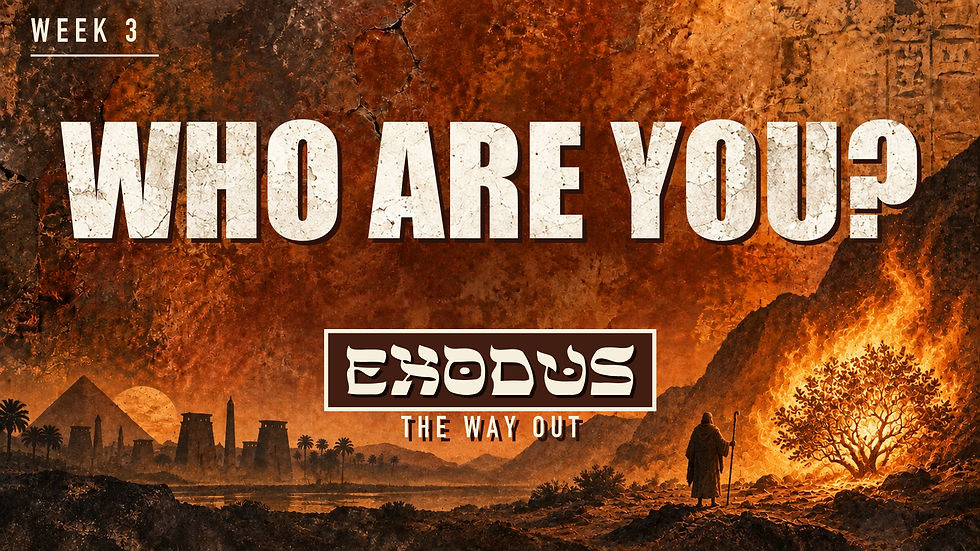
Exodus 3 & 6 | Who are You?
Exodus: The Way Out | Week 3
This small group study and discussion guide is based on the sermon preached at Valley Life Church on September 27, 2026. The sermon video and audio is available on our website, YouTube, and your preferred podcasting app.
OVERVIEW
This week's sermon explored Moses' second objection to God's call at the burning bush. Having previously asked "Who am I?", Moses now turns the question around and asks, in effect, "Who are You?" The sermon traced how God answers that question not just with words, but through the entire unfolding story of Exodus - revealing His character, His faithfulness, His power, and His supremacy, all tied directly to His name, Yahweh. Ultimately, the sermon landed on a central truth: redemption is not found from within. It is found in who God is and what He has done.
KEY TAKEAWAYS
God's personal name, Yahweh, is derived from the Hebrew verb meaning "to be" or "to exist." It is not merely a label but a declaration of His eternal, self-sufficient nature.
Throughout Exodus, God repeatedly uses the phrase "I am Yahweh" to attach new revelations of His character - His mercy, justice, faithfulness, and power - directly to His name.
The question "Who are You?" can be asked in two very different ways: with genuine curiosity and openness, as Moses asked it, or with defiance and dismissal, as Pharaoh asked it.
Exodus 6 contains the first use of the verb "to redeem" in the entire Bible, setting the trajectory for understanding redemption that finds its fullest expression in Jesus.
True redemption does not come from within us. It comes from God; from who He is and what He has done.
GETTING THE CONVERSATION STARTED
Begin your group time with one of these lighter questions to help everyone engage before moving into deeper discussion.
If someone who had never met you asked a mutual friend "Who is that person?", what do you hope that friend would say about you? What would you want your name to be associated with?
Think of a time in your life when you genuinely wanted to know more about someone. What made you curious about them? What did getting to know them better change for you?
DISCUSSION QUESTIONS
Exploring the Text
In Exodus 3:13-15, Moses asks God for His name. Read the passage together and discuss: why do you think knowing God's name mattered so much to Moses in that moment? What was he really looking for?
The sermon explained that God's name Yahweh is built from the Hebrew verb meaning "to be" or "to exist." What does it tell you about God's nature that His personal name is rooted in the concept of existence itself?
In Exodus 6:2-8, God uses the phrase "I am Yahweh" to open and close His message, with a third occurrence right at the center. What do you think God is communicating by structuring His words that way? Why does He keep returning to His name?
The sermon pointed out that Moses asked "Who are You?" with openness and a desire to know more, while Pharaoh asked essentially the same question with dismissal and defiance. What do you think made the difference between those two responses? What does each posture produce in a person's life?
Exodus 34:6-7 is described in the sermon as a culmination of God's self-revelation in Exodus: merciful and gracious, slow to anger, abounding in steadfast love, yet one who will not clear the guilty. How do you personally hold those two sides of God's character together? Which side do you find easier to believe? Which is harder?
Connecting to Our Lives
The sermon described how God's repeated declaration "I am Yahweh" was meant to help the Israelites connect His character and His actions directly to His name, so that when they saw what He did, they would know who He is. Has there been a season in your own life when circumstances helped you understand something about God's character that you had not seen before? What did you come to know about Him through that experience?
The sermon drew a parallel between Israel's slavery in Egypt and the spiritual bondage that people experience today - captivity to this world, a lack of identity, a need for redemption. How does that parallel land with you personally? In what ways have you experienced or are you experiencing a need for that kind of freedom?
Moses had to come to the end of himself - recognizing that there was nothing within him that could accomplish what God was calling him to do - before he was ready to truly learn who God was. Have you ever had a "end of yourself" moment? What did that experience teach you about who God is?
The sermon closed by pointing to Ephesians 1:7, which describes redemption through the blood of Jesus as the fullest expression of what God began to reveal in Exodus. How does seeing the Exodus story as a foundation for understanding the cross change or deepen the way you think about what Jesus did?
When the Israelites crossed to the other side of the Red Sea, their response to seeing God's character and power on full display was to sing; to lift up His name in worship. What would it look like in your daily life to respond to who God is with that same kind of declaration?
PRACTICAL APPLICATIONS
Choose one or more of the following to practice individually or as a group before your next meeting.
Personally
Spend time this week reading Exodus 15:1-18, the song Moses and the Israelites sang after crossing the Red Sea. Sit with it slowly. What does it reveal about who God is? Write down two or three characteristics of God that stand out to you and reflect on how you have seen those characteristics at work in your own life.
The sermon noted that in Jewish tradition, God's name Yahweh became so sacred that people stopped saying it aloud out of reverence. This week, pay attention to how casually or carelessly you may use God's name in everyday speech. Ask yourself: does the weight I give to His name reflect what I actually believe about who He is?
Identify one area of your life where you are still trying to find redemption or rescue from within yourself - through your own effort, willpower, or self-sufficiency. Bring that area before God in prayer this week, surrendering it to Him and asking Him to remind you that redemption is found in Him, not in you.
As a Group
Consider taking a few minutes at the start of your next group meeting for each person to share one thing they have come to know about God's character through a difficult or surprising experience. Use it as a way of declaring together, as the Israelites did, who God has shown Himself to be.
As a group, read through Exodus 6:6-7 together out loud. These were God's words spoken to people who were still enslaved, who had not yet seen the deliverance He was promising. Discuss: what does it mean to hold onto who God says He is before you have seen the outcome? How does your group encourage one another to do that?
CLOSING PRAYER
Close your time together by inviting group members to pray in response to what was discussed. You may use the following as a guide:
Thank God for revealing Himself, not just through words, but through His actions in history and ultimately through Jesus. Confess any ways your group has asked "Who are You?" with Pharaoh's posture rather than Moses' posture - dismissing or ignoring what God has made known about Himself. Ask God to give each person in your group a growing understanding of His character tied to His name, so that when you lift up His name in worship, it is a declaration rooted in genuine knowledge of who He is.
LOOKING AHEAD
Next week the group will continue through the book of Exodus, examining the next objection Moses raises in response to God's call. As you prepare, consider reading Exodus 4:1-9 and reflecting on what it reveals about the nature of trust and doubt in our relationship with God.
Comments