


Exodus Week 2: Small Group Guide
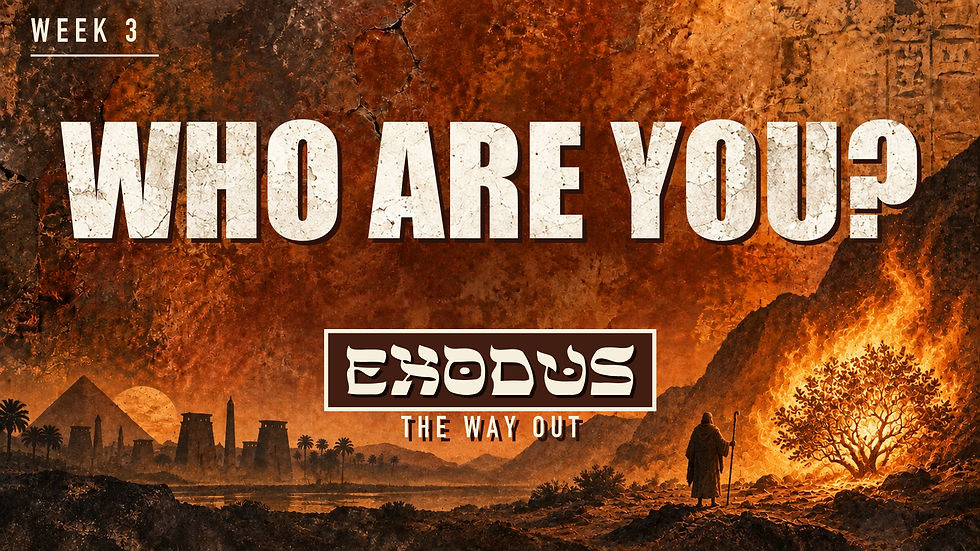
Exodus Ch. 3 | Who Am I?
Exodus: The Way Out | Week 2
This small group study and discussion guide is based on the sermon preached at Valley Life Church on September 20, 2026. The sermon video and audio is available on our website, YouTube, and your preferred podcasting app.
CONTEXT FOR THE DISCUSSION LEADER
This week's sermon continued the series through the book of Exodus. Pastor Adam walked the church through the background of Moses in Exodus 2 and then zoomed in on the pivotal moment of the burning bush in Exodus 3. The central tension of the passage is Moses' question, "Who am I?" and God's response: "I will be with you." The goal of your group time is to help members move from asking "Who am I?" to asking "Whose am I?"
KEY TAKEAWAYS
God sees, hears, remembers, and knows his people - even in the middle of suffering and uncertainty.
Moses carried a fractured and conflicted identity his entire life, shaped by abandonment, adoption, failure, and exile.
When Moses asked "Who am I?", God did not answer by telling Moses to look within himself. He answered by pointing Moses to his own presence.
The decisive question is not whether we are enough. The decisive question is whether God is with us.
Moses was not enough, but he was not alone. Neither are we.
The most important truth about any of us is not what we have done, what others call us, or how we see ourselves. It is whose we are.
OPENING QUESTION
Use this question to get the conversation started. Keep it light and accessible.
Think of a time when someone gave you a label - a nickname, a reputation, an assumption about who you were - that did not feel accurate. How did it affect you?
DISCUSSION QUESTIONS
Work through these questions at whatever pace fits your group. You do not need to cover every question. Follow the conversation where it leads.
Exploring the Text
In Exodus 2, Moses' identity is pulled in several directions at once. He was raised as Pharaoh's grandson, he identified the Hebrews as his own people, and the women in Midian saw him as an Egyptian. Have someone in the group summarize those three major moments from Moses' life in chapter 2. What do those moments tell us about the tension Moses was living with?
Read Exodus 3:11 together. Moses asks, "Who am I that I should go to Pharaoh and bring the children of Israel out of Egypt?" Pastor Adam suggested this is more than a question about qualifications - it is an existential question about identity. Do you agree? What in Moses' background supports that reading?
Read Exodus 3:12 together. God does not answer Moses' question directly. He does not say, "You are the right man for this job" or "Here is why you are qualified." Instead, he says, "I will be with you." What does it tell us about God that this is his answer?
Going Deeper
Pastor Adam said that God "didn't respond by strengthening Moses' self-image. He redirects Moses' attention and his eyes to God's own presence with him." In our culture, the more common response to someone who feels inadequate is to tell them to believe in themselves or recognize their own worth. What is the difference between that approach and what God does here? Why does it matter?
Pastor Adam noted that Moses was nearly 80 years old when he asked "Who am I?" He said, "We don't ever graduate or outgrow wrestling with who we are." Where in your own life do you find yourself still wrestling with that question, even at your current stage of life?
The sermon introduced a reframe: instead of asking "Who am I?", the better question is "Whose am I?" What changes when you approach your identity from that angle? What becomes less important? What becomes more stable?
Connecting to the Larger Story
Exodus 2:23-25 tells us that God heard, remembered, saw, and knew his people in the middle of their suffering. How does knowing that God is attentive to your situation - not distant or forgetful - affect the way you carry your own struggles or uncertainties?
Pastor Adam connected Moses' story to the table of communion - the reminder that we belong to God because he purchased us through the death and resurrection of Jesus. How does the gospel shape the answer to the question "Whose am I?" in a way that goes beyond even Moses' experience?
PRACTICAL APPLICATIONS
Encourage group members to choose at least one of these before you meet again.
Identify the labels. Take some time this week to write down the labels others have placed on you over your life - positive and negative. Then write down what God says is true about you. Sit with the contrast.
Memorize the response. Commit Exodus 3:12 to memory this week. When you feel the weight of inadequacy or confusion about who you are, return to God's answer: "I will be with you."
Have an honest conversation. If there is someone in your life - a student, a friend, a family member - who is visibly wrestling with questions of identity and belonging, reach out to them this week. You do not need to have all the answers. Simply being present is part of what God models in this passage.
Bring it to prayer. Spend time in prayer this week specifically naming the areas where you have been asking "Who am I?" and asking God to help you rest in the truth that you are His and He is with you.
CLOSING PRAYER PROMPT
Close your time together by praying over your group members by name. Ask God to anchor each person's sense of identity not in their past, their failures, or others' opinions, but in the truth that they belong to him and that he has promised to be with them.
This week we looked at Moses' first objection to God's plan for His people and calling on Moses' life. Next week we will look together at Moses' second objection.
Comments